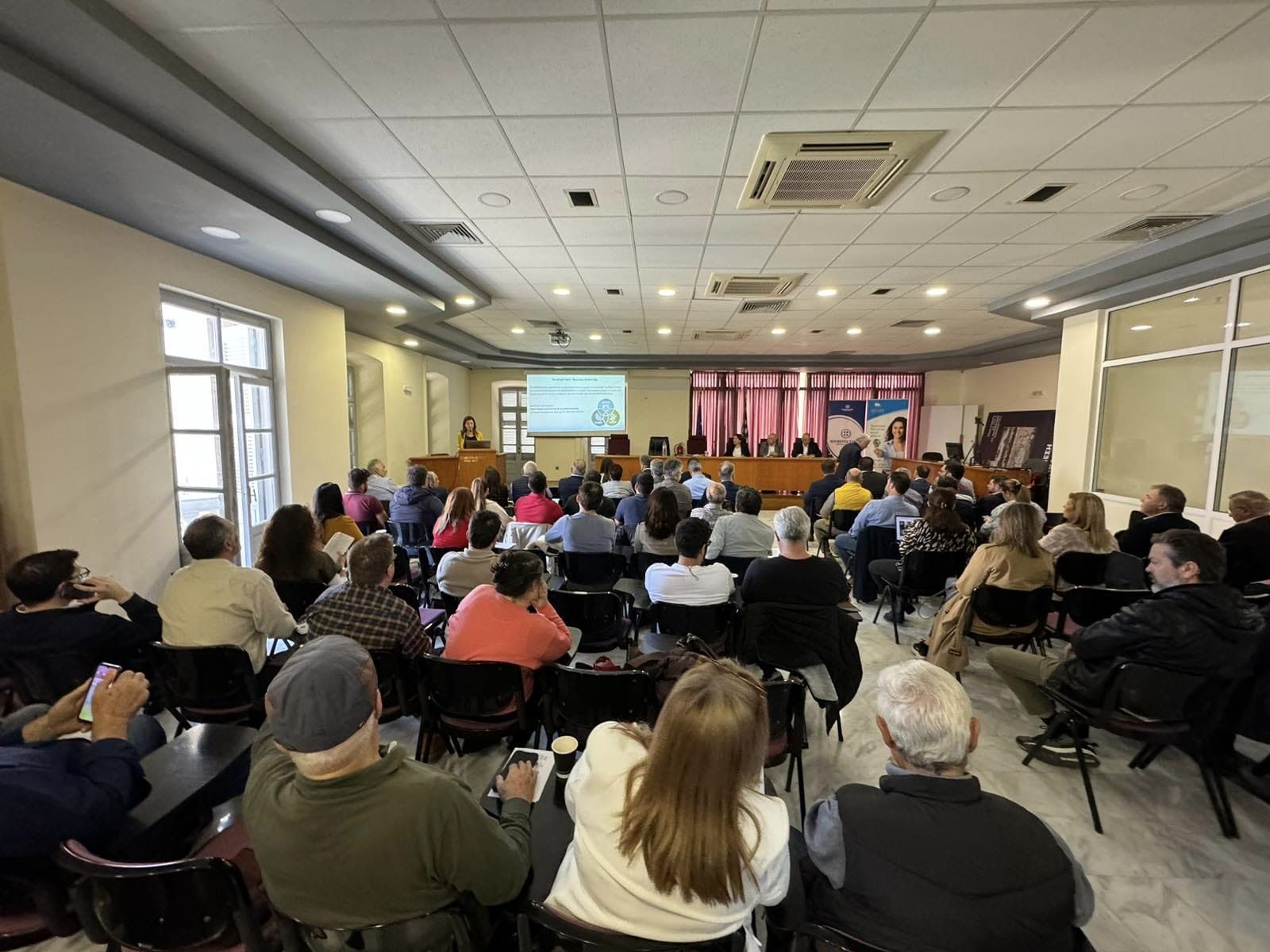
In a historic gathering, five institutions of Crete, mayors, members of parliament, and numerous active citizens met on Saturday, March 30, to discuss Crete’s energy challenge at a time when the stakes of the transition from fossil fuels to renewable energy sources are high and decisive for the future of the next generations.
The Region of Crete, the Technical Chamber of Greece – Eastern Crete Department (host of the event), the Heraklion Chamber of Commerce & Industry, the Geotechnical Chamber of Greece – Crete Branch, and of course the Minoan Energy Community, which conceived and organized this important meeting, opened the discussion on how the people of Crete envision the use of the island’s energy resources, guided by sustainability, environmental protection, and fair participation in the development these resources can generate.
It is widely accepted that Crete is an attractive destination not only for its natural beauty and high‑quality products but also for its significant energy potential. And it is the duty of Cretans to safeguard and utilize this potential in a fair way, for the benefit of all.
This was the core message of the opening address by Ms Gialiti, special advisor to the Regional Governor of Crete and member of the Board of Minoan Energy, who moderated the discussion. She emphasized that this is the first time such a broad event on the allocation of energy space on the island has taken place, with the support of Chambers, local authorities, and institutions—something particularly important for a just energy transition toward a fossil‑free economy.
Regional Governor Mr. Arnaoutakis stressed that “renewables alone are not enough. A redesign of the market is needed—one that takes into account energy democracy and justice for the benefit of citizens. We are convinced that the path to the energy transition goes through the fair distribution of energy space on our island.” He concluded by saying: “In any case, the energy transition must be carried out with society as an ally, because anything done without society is doomed to fail. The Administration must also contribute to this effort. We are convinced that Energy Communities, as collective initiatives for society, must have strong incentives such as licensing priority, state subsidies, guarantees for financing virtual net‑metering projects, and other advantages.”
Mr. Giannopoulos, President of Minoan Energy, after thanking the Region of Crete for its example through participation in the Community and the Technical Chamber for its interventions as the state’s technical advisor, highlighted the problem of insufficient energy infrastructure, which has led to horizontal curtailments of renewable energy production—even for vulnerable social groups. He then referred to a series of distortions in the institutional framework for Energy Communities, which instead of being protected are being undermined, resulting in the creation of virtual communities at rates reaching up to 95%. He emphasized the need to prioritize the implementation of renewable energy projects by Energy Communities over large private companies, which ultimately occupy hundreds of times more energy space than collective schemes.
Mr. Tavernarakis, President of TEE‑TAK, stated that the EU’s 2050 targets favor the development of renewables; however, their penetration in Greece’s energy mix has not reduced costs for consumers. At the same time, the inability to obtain connection terms and the disorderly siting of renewable projects have led to a decline in renewable energy production in Crete. He presented several proposals, including prioritizing broad‑based Energy Communities, accelerating licensing, canceling large private wind farms, subsidizing municipalities for net‑metering projects, promoting pumped‑storage and hydrogen projects, and utilizing biomass for energy production.
Mr. Kegeroglou, Mayor of Minoa Pediadas, spoke about powerful private interests seeking to control Crete’s energy space while citizens are offered social electricity tariffs. He stressed the need for both municipalities and citizens to gain the ability to produce energy in order to reduce the inequalities that characterize Greek society. Finally, he called on the Region to use its influence to halt the implementation of large private energy projects in Crete.
Deputy Regional Governor for Environment Mr. Xylouris emphasized the need for strong and comprehensive documentation in decisions related to renewable energy projects by private companies, so that they do not collapse later in court. He also highlighted the Region’s commitment to ensuring that energy space is used for the benefit of Crete’s citizens.
The Mayor of Archanes–Asterousia, Mr. Kokosalis, firmly opposed the development of large private wind farms on Crete’s mountains and stressed the need for coordination between municipalities and the Region.
Mr. Alifierakis, President of the Heraklion Chamber of Commerce & Industry, expressed the desire of businesses to participate in the energy transition, while Mr. Koutentakis, President of the Energy Community created by the Chamber, highlighted the challenges they faced in implementing their project. Despite the difficulties, he noted that the business community wants to be part of the solution by creating products and services with a low energy footprint.
Ms. Daskalaki, President of the Geotechnical Chamber of Crete, stressed the need for the agricultural sector to participate in the energy transition discussion. She also emphasized the need for training and informing farmers, as well as redesigning rural development programs to support renewable energy investments in the primary sector.
A more pessimistic view was expressed by MP and head of the energy sector of PASOK‑KINAL, Mr. Parasyris.According to him, Crete’s energy space has already been occupied by just two private companies following a political decision to meet the ambitious targets of the National Energy and Climate Plan by 2030. As a result, citizens received less than 3% of the grid’s capacity. Furthermore, the “Apollon” program, as currently designed, does not create a community of producers—as it should—but a community of consumers in which the Region, municipalities, and vulnerable groups will buy supposedly cheap energy through bilateral contracts with large producers. He concluded by describing a major injustice that has taken place in Crete, which cannot be solved politically but only through a collective social response.
The final speaker was Professor Katsaprakakis, of the Hellenic Mediterranean University and founding member of Minoan Energy. He emphasized that Crete has one of the highest‑quality wind energy potentials in the world, and in terms of solar energy it can easily compare with Middle Eastern countries. Combined with the island’s abundant biomass, clean energy production could become Crete’s most important product. He highlighted the impacts—on both the environment and human life—of large‑scale wind projects, which due to their size cannot be effectively controlled. These projects ultimately slow down renewable energy penetration due to strong social reactions and infrastructure saturation, resulting in their non‑implementation. He stressed that they represent the greatest economic and social threat to future generations. He added that Crete’s scientific personnel—at the Universities, the Technical University, and the Foundation for Research and Technology—are capable of identifying both the type and location of renewable projects that would make the island energy‑autonomous. He pointed to Minoan Energy as an example of a truly just energy transition and urged participants to reflect on their responsibility, recalling Thucydides’ saying: “We must choose between being free or being at ease. We cannot be both.”
Citizens’ interventions followed, highlighting the need to repeat similar events in municipalities across Crete, with citizen participation, to strengthen the collective voice demanding that the island’s energy wealth be allocated primarily to its residents.
The event concluded with the reading of a joint text summarizing the decisions and demands of the institutions and active citizens of Crete on the critical issue of the energy transition and the allocation of the island’s energy space. The summary text is available here and the related press release is available here
It should be noted that the event took place within the framework of the EU‑funded Horizon 2020 project WENDY of the Minoan Energy Community.
 English (UK)
  Ελληνικά